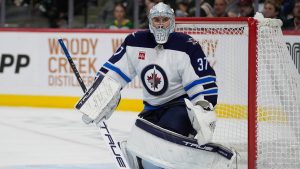
VANCOUVER — In about the time the World Cup of soccer has been on, new Vancouver Canucks general manager Ryan Johnson hired a head coach, hired an assistant GM to manage the minor-league team, hired a head of player development, made his first big trade and key changes to the team’s identity, and oversaw the most important draft in franchise history.
Imagine what he might do over an entire season.
With the rush of free agency over, Sportsnet caught up with Johnson on Wednesday to discuss what has happened and what comes next. We talked the Marcus Pettersson trade, the Elias Pettersson trade rumours, Filip Hronek, fending off offer sheets, a coaching staff that will have limited National Hockey League coaching experience, lineup spending limits (he hasn’t any) and exhaustion.
Sportsnet: You said the other day you’ve been sprinting since you took the job in May. With all that has been coming at you, we gather the last few weeks have been like drinking water from a fire hose. How hectic has it been?
Ryan Johnson: I knew that it was going to be a sprint. I knew a lot of decisions were going to have to be made with the draft and free agency, and the environment that I wanted to kind of implement right from Day 1. But as the days went by, the to-do list kept getting longer and the amount I was checking off was getting shorter, so I had to really just ... start prioritizing. At the time it was like, ‘How do I ever get to July 8?’ There's still lots to get done, but I was happy with the draft and what we were able to accomplish around and through free agency. We’ve given this group a different look and different feel. I expect in the next day or so to (finalize) our coaching staff. So it's just, you know, slowly checking these boxes off.
SN: Have there been any big surprises?
RJ: No, there's nothing that has really surprised me. I was very well aware it was going to be a tall task, short term and long term. I came into it with a lot of humility and not, ‘Hey, I know everything, this is going to be simple.’ I feel very good with the (hockey operations) group around me, and feel like we've been able to make some small and big decisions that were true to our word of what the vision is and how we want to treat people. We've stayed on task with that.
SN: The rebuild will be measured in years. But with the initial roster changes you’ve made, trading defenceman Marcus Pettersson and allowing three other veterans to leave in free agency while adding Jamie Oleksiak, Brendan Gallagher, Luke Schenn and Paul Cotter, are you happy for now with where the roster is — at the start of the rebuild?
RJ: I like a little bit of the facelift and the addition of some size and speed, and some really high-character people that I think have changed the outlook of some of our players that have been here previously. But it's not like we’re closing up shop because we’re ready to go; I've always got to be on my toes and willing to listen on anything that I think helps us build what we're trying to build here.
SN: Your predecessor, Patrik Allvin, was honest about the lack of interest at times from other teams in your veteran players due to problems in Vancouver over the last two seasons. No one was really expecting a Marcus Pettersson trade, so was that a deal you made because you could?
RJ: I had a really good conversation with Marcus about this. I wanted him to understand that by no means was this an agenda of mine. But as you're fielding calls and seeing where interest lies, you often can tell when teams are just kicking tires or when they really want to get something done. And it just felt it got to a point (with the New York Rangers) ... where the acquisition cost was something that I felt I should take to Marcus to allow him to make a decision. Like I've said, any of our players that have (trade protection) in their contract, they have every opportunity to say no. But you look at assets that you can get back for your players, and where we are with the state of this organization, it was something that I felt I needed to take a long look at. And then to pivot on a dime to be able to bring in somebody similar to Marcus in (free agent Oleksiak) ... it was a very fast pivot.
SN: Former president Jim Rutherford made it clear late last season that Filip Hronek was potentially the Canucks’ next captain and, essentially, untouchable. Is Hronek untouchable and, if so, why?
RJ: Well, Fil has been really adamant that he wants to be a part of the solution. Nobody shuts off their phone and doesn't listen on anybody's ideas or what other teams want. But at the end of the day, I've got to think about how it affects the group here. Fil really wants to help the young players; he has already reached out to some of the newly drafted players to welcome them. Fil maybe doesn’t want to be the centre of attention as far as media and those types of things, but he very much is operating like somebody that really wants to help this group moving forward. There's a lot of value in him not just as a player, but as a person. That’s how we've gotten to where we are.
SN: You’ve been asked about Elias Pettersson every time you’ve been available to the media, so we’ll keep that streak going. There has been lots of conjecture this week about potential interest from the Pittsburgh Penguins. Trade rumours involving Pettersson have been going on for two years. Do you need to find closure — either with a trade or a declaration that he will remain part of the Canucks for the next while?
RJ: Without going into details, Petey and I have had a very open dialogue since I've come on board — a real sense of just being honest without judgment. I have a tonne of respect for Petey, his journey, and how he's gotten to this point. It's not just Petey, but with every player in our group, I have to consider what's best for the organization. I've wanted to make sure there's a clear dialogue, clear honesty ... while trying to find solutions that benefit the player and the hockey club at the same time.
SN: You clarified before the draft that this rebuild is not a “selloff,” that you’re not simply trying to liquidate the older end of the roster to shed contracts. Can we assume that if there are any trade discussions involving Elias, it’s not about a salary dump? You would need genuine assets in return?
RJ: One hundred per cent. There is no aspect to anything going on with us and Petey that is about — I won't even say the words (salary dump). That is not the situation we’re in. I've been very clear that's not an avenue we’re going down.
SN: As far filling out the coaching staff, American Hockey League coach-of-the-year Ryan Mougenel has been widely reported to be coming as Manny Malhotra’s top assistant. A lot of people thought adding an assistant with significant NHL experience would be a priority because Malhotra is a first-time NHL head coach. Why would you be comfortable with a staff that has little coaching experience in the league?
RJ: I went through this one time already with Manny when I brought him on board two years ago in Abbotsford (to be the Canucks’ AHL coach). My intention then was to surround him with some experience because he was a first-time head coach. But as we went through the (hiring) process, talking to the people we talked to, we just felt like the best group was the best people. We were getting caught up in experience, and maybe not getting the best people. So we pivoted and made a decision to go with people that we felt we could work with and build with — that they had the traits, the energy and the personalities to complement Manny and the team. I would say the same process and conversations went into this. Would (NHL) experience be of great assistance? Yes. But if it didn't fit the energy or ... those non-negotiables — the acumen, the ability to teach, the ability to connect — are we focusing on just one aspect when we should be putting the best staff in place? So that's been the same approach this time.
SN: There was a seismic shift across the NHL last weekend when Leo Carlsson, the Anaheim Ducks’ best player, signed an offer sheet with the Philadelphia Flyers that would make the 21-year-old the highest-paid player in hockey at $18 million per season. The Ducks just emerged from a painful rebuild that saw them miss the playoffs for seven seasons. With the salary cap skyrocketing, how concerned are you that offer sheets like this one become common and that young teams like the Canucks — if you are successful in developing players like Zeev Buium, Caleb Malhotra and Braeden Cootes — become especially vulnerable?
RJ: The evolution of where the cap has gone ... the landscape has completely changed in a short amount of time. Where we sit as an organization, it’s something that we've talked about, even this morning, and are looking at internally with the path of our group and players. There are things that we can be proactive with and should be thinking about. It would be naïve ... to think it’s not something we've got to worry about. You better be prepared and have a plan of what you want to do and how you want your players to feel.
SN: Even during dismal seasons recently, the Canucks were a team that spent to the salary-cap limit. Obviously, it doesn’t make much sense to do that now, but do you have the authority to spend whatever you feel you need to spend on players during the rebuild or is there an internal salary cap?
RJ: We've got the ability to do whatever we think gives us the best opportunity to execute the vision and the plan that we have in place. You saw with us trading Marcus, it wasn't about replacing him with somebody making the minimum. We fully have the ability to make decisions as long as we are sticking to the plan, short term and long term. There is no (internal) limit.
SN: After the draft and free agency, what does a good summer look like for you?
RJ: There’s still lots to be done. I still have hirings and things internally that I've got to do. I haven't said, ‘OK, great, we’ve had a good six weeks here and now let's just sit back and see what happens.’ I've got to continue to look at opportunities to improve this group.
SN: Is the flow of water through that fire hose starting to ease?
RJ: Going back to August of 2024, it has been a long stretch of not stepping back. We won the Calder Cup (in June 2025), and while we were celebrating that, I was preparing for the draft and free agency. And then before you know it, it was training camp again. So at some point, I've got to just take a couple deep breaths and recharge. But, you know, I was talking to (centre) Filip Chytil this morning, and as much as I should be ready to take a break, I'm also so excited to see the guys walk back in this facility and get going again.